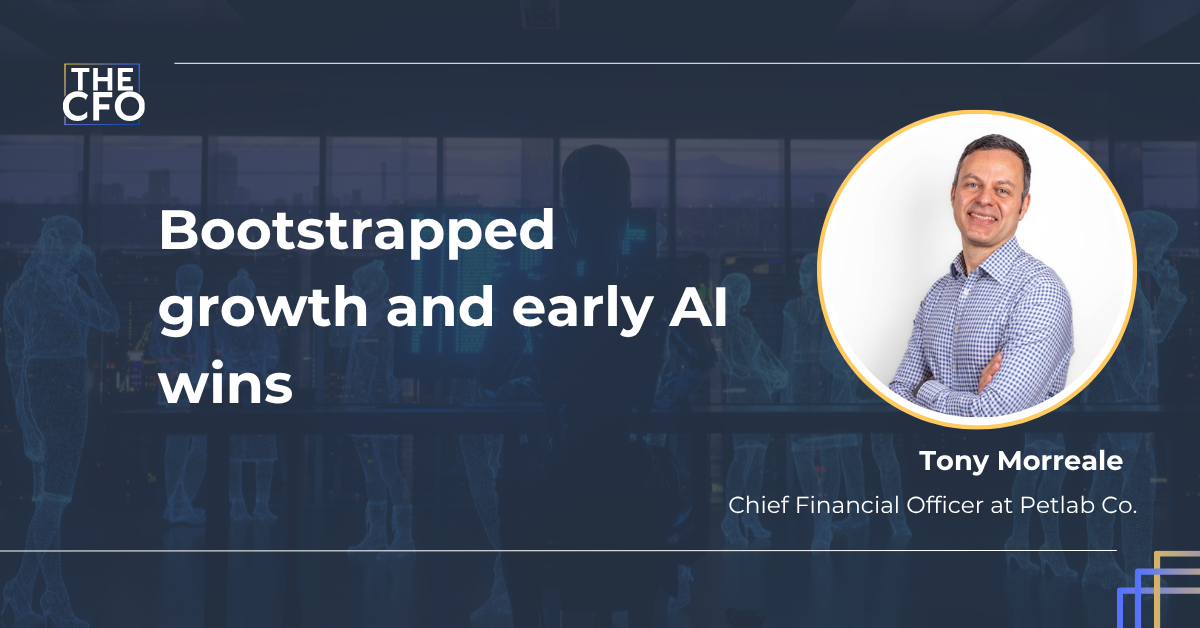
PetLab Co. CFO on bootstrapped growth and early AI wins
At SuiteWorld 2025 in Las Vegas, PetLab Co.’s chief financial officer Tony Morreale explained how a bootstrapped pet supplement brand scaled its finance backbone, why SKU-level profitability now drives decisions, and the targeted AI use cases that are saving hours today.
When Tony Morreale joined PetLab Co. in its early years, the business was already growing fast. Founded in 2018, the pet supplement company had quickly become one of the leading names in the North American market, which now accounts for 95% of its revenue. But with that growth came a familiar challenge for a young, bootstrapped business: scaling finance operations without losing control.
“We were completely bootstrapped as a business with no external funding,” said Morreale, speaking to The CFO at SuiteWorld 2025 in Las Vegas. “Managing cash flow was really important, and getting robust data points to senior management was critical. The business was growing so fast that the back office just couldn’t keep up. I came in to build a proper finance function from the ground up.”
That effort began with implementing Oracle NetSuite. For Morreale, the ERP was less about technology adoption and more about creating discipline in financial reporting.
“NetSuite is more than an ERP system. It’s a holistic platform of data points for the business,” he explained. “The basics are about getting robust financial information to senior management, but beyond that, it’s about visibility, inventory management, SKU-level profitability, and channel performance. Those data points are now critical for decision-making.”
Unifying financial and operational data meant Morreale and his team could move from reactive reporting to proactive analysis.
“Once the hygiene factors were done, I could focus more on the high-value areas – what they’re actually paying my salary for,” he said with a laugh. But that transformation wasn’t only technical, it was also cultural.
“Any CFO is only as good as the team underneath them,” Morreale said. “When you implement a new system, you’ve got to involve people in the journey. I had an 11-person team, some great people I inherited, and others I brought in. They were part of the process from the start, identifying pain points and helping shape the solution.”
Automating for accuracy
PetLab Co.’s journey with automation is still evolving, but the results so far have been striking. The finance team recently implemented a third-party solution integrated with NetSuite to automate bank reconciliations and transaction coding, an early step toward more intelligent financial operations.
“It picks up all transactions, learns from past patterns, and predicts where they should go in the general ledger,” Morreale explained. “It saves so much time. We’ve gone from 100% manual intervention to just 5% of transactions needing review. That’s a massive improvement.”
While AI is transforming finance across industries, Morreale remains pragmatic about its implementation. “Lots of businesses say they’re doing AI, but not many are doing it effectively,” he said. “We started small – automating repetitive processes like reconciliations – and we’ll build from there.”
The company’s approach to new technology follows the same discipline it applies to product development: start with the basics, then layer on improvements.
“When we implemented NetSuite, we went for the minimum viable product first,” Morreale said. “Once that was stable, we began adding functionality and now we’re layering in AI tools where they make sense.”
Data-driven product decisions
The integration of finance and operations has also changed how PetLab Co evaluates performance. “We’re constantly assessing our products,” Morreale explained. “We track sales data and gross profit margins closely, because we spend heavily on media. With the data from NetSuite, we can analyze profitability by SKU and channel, see where margins can be improved, and reformulate products accordingly. It’s made us more nimble.”
That agility, he said, has allowed the company to refine its product mix and protect margins even as it scales. “We can now see clearly where the most profitable SKUs are and where we can improve. That visibility is a game changer.”
What’s next for PetLab Co.
Automation has already delivered measurable efficiency for the finance function even without expanding the team. “We had 11 people in finance when I joined, and five years later, we still have 11, despite exponential growth,” Morreale said. “That’s down to automation and having a robust system in place.”
When asked what manual process he would most like AI to eliminate next, Morreale didn’t hesitate: “Preparing the monthly pullback,” he said, smiling. “It’s something we’re already exploring – how to capture and visualize that data as soon as possible.”
As PetLab Co. moves into its next phase, the company’s ambitions are growing.
“We’ve just received private equity funding. They’re now majority owners and will help us accelerate growth,” Morreale said. “So far, we’ve been an online-only business, but we’ll be moving into brick-and-mortar retail and investing more in R&D. The goal is to create the best-in-class, cutting-edge products for pet parents everywhere.”
For Morreale, the next stage isn’t just about expansion but about building on the systems and culture that made scaling possible. “We’re still a growth business,” he said, “but now we’ve got the data, the tools, and the people to scale with confidence.”