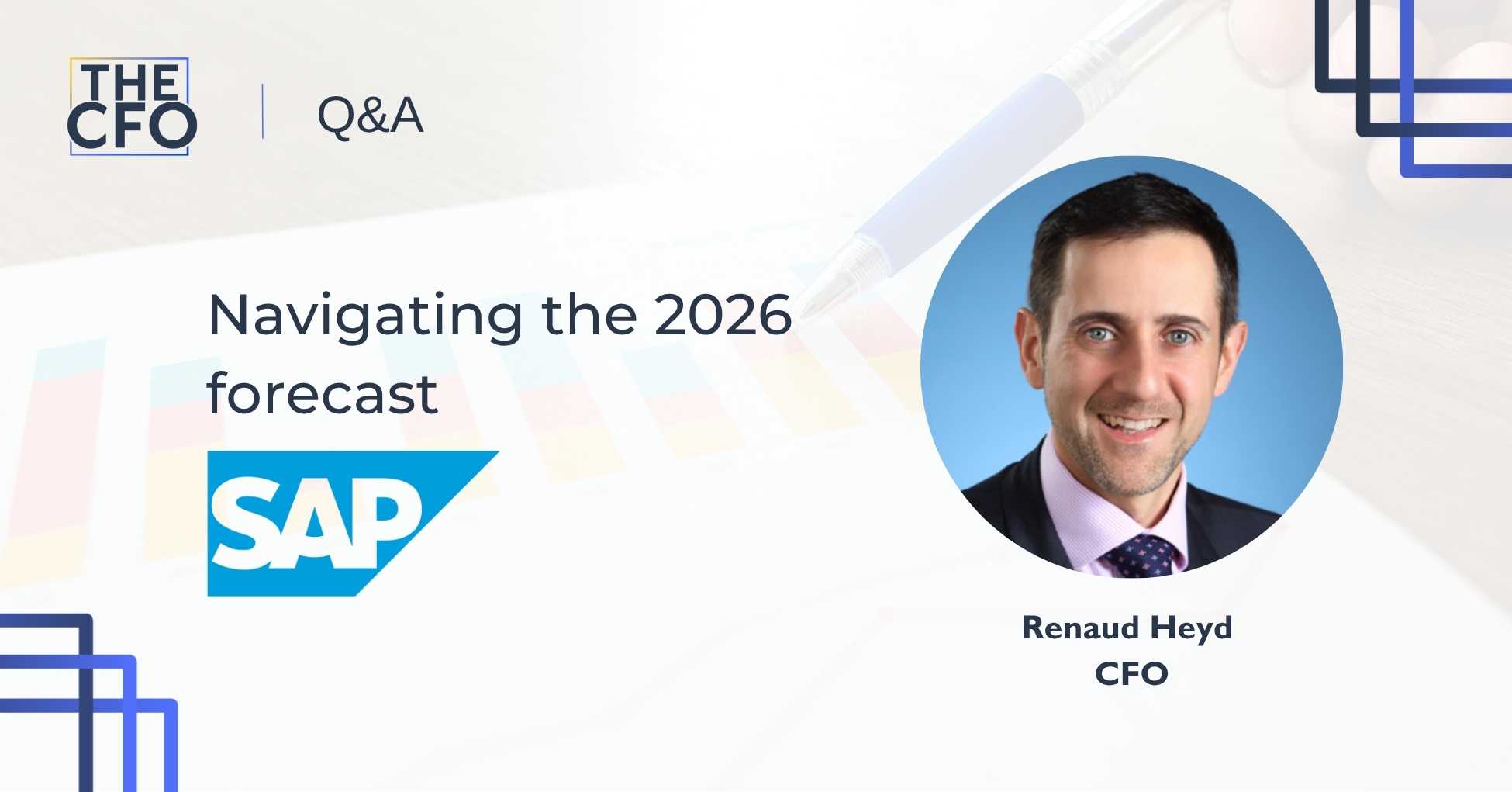
Navigating the 2026 forecast with SAP’s Renaud Heyd
In a world where market shifts happen in seconds, the traditional "rearview mirror" of finance is a liability. Renaud Heyd, CFO of SAP, explores how AI-driven algorithms and real-time data integration are transforming the year-end close from a period of firefighting into a launchpad for 2026 strategic agility.
As the first quarter of the year reaches its crescendo, CFOs find themselves at a familiar, albeit exhausting, crossroads: the high-stakes push to finalize the previous year’s books while simultaneously steering the ship toward a 2026 horizon.
In this edition of The CFO, we sit down with Renaud Heyd, CFO of SAP, to discuss how technology is effectively killing the “rearview mirror” of finance. From the cockpit of a private plane to the boardroom of a global tech giant, Heyd shares his philosophy on “drinking your own champagne,” the necessity of 80% accuracy, and why the most important financial system in 2026 might actually be your HR platform.
Eliminating the Rearview Mirror
For many finance teams, the year-end close is a period of looking backward. For Heyd, that concept is obsolete.
“The strength of our forecasting process, powered by advanced algorithms, ensures everything we do is forward-looking,” Heyd explains. “In fact, about 90% of my forecasts are generated by algorithms. By the time we approach the close, I already know what will appear in the books before the accountants even begin.”
This level of certainty is a strategic safeguard. Heyd warns that “surprises” even positive ones, are essentially failures in prediction. Over-cautious forecasting can lead to delayed hiring or missed investment opportunities that could have delivered results sooner.
The “80% Rule” and the Steering Wheel
Accuracy is the bedrock of finance, but Heyd argues that the “Finality Trap” waiting for 100% perfection can be fatal to agility.
Drawing on his experience as a private pilot, Heyd notes: “Every second you spend thinking can turn a situation from messy to dangerous. It’s the same at the financial steering wheel. You need to make decisions and act every second.”
“Having real-time data that is 80% accurate is good enough to make a fast, agile decision. If you overthink and wait for all the numbers to be there, there is more risk of failure.”
By leveraging tools like SAP Analytics Cloud and Fiori, Heyd’s team maintains real-time visibility into P&L and balance sheet builds, allowing them to pivot long before the final statutory reports are signed.
Gamifying the Boardroom: Beyond the “Base Case”
In a volatile economy, a static, single-point forecast is outdated the moment it hits the screen. SAP’s internal approach involves “gamifying” business planning. Instead of months of manual Excel work, board members can now tweak drivers in real-time to see immediate impacts.
“You can literally have board members sitting around a keyboard to see the effect of increasing sales productivity or marketing spend on the fly,” says Heyd. This dynamic modeling relies on identifying the specific “value driver trees” that move the needle for revenue, profit, and customer satisfaction.
Breaking Silos: Why HR is a Finance System
One of the most profound shifts in Heyd’s strategy is the integration of financial and non-financial data, specifically from HR systems like SuccessFactors.
“SAP is a people business. As a CFO, I see our HR system as my most important financial system,” Heyd admits. By integrating HR data with the S/4HANA ERP, the finance team can identify market shifts through human capital metrics. If a territory is underperforming, the data reveals whether it’s a market issue or a resource alignment issue, allowing for immediate action before the dip ever hits the P&L.
The 2026 Roadmap: AI and the Mid-Market
As we look toward 2026, Heyd sees two primary paths for AI ROI:
The Immediate Path (Automating the Close & Compliance): Applying AI to reconciliations and journal preparation to move away from “month-end firefighting.” Renaud highlights how SAP “drinks its own champagne” by using SAP Concur to automate expense monitoring, acting as a “financial firewall” that catches non-compliance instantly and ensures a cleaner data foundation.
The Strategic Path (Predictive Modeling): Shifting from reporting outcomes to actively steering cash flow and liquidity.
For mid-market CFOs who lack the massive infrastructure of a global enterprise, Heyd recommends a “minimum viable tech stack” focused on scalability. He points to offerings like Grow with SAP, which provides cloud-based access to enterprise-grade tools, real-time data, predictive analytics, and the same automated expense management capabilities found in SAP Concur without the traditional IT complexity.
The Takeaway for the 2026 CFO:
Trust the Algorithm: Aim for 90% automated forecasting to free up strategic bandwidth.
Prioritize Agility: 80% accuracy today is often more valuable than 100% accuracy next week.
Integrate Data: Treat your HR and non-financial data as core components of your financial steering.