Why AI is the last thing CFOs are willing to cut
Faced with paused capex and fresh rounds of cost-cutting, finance leaders are doubling down on targeted AI bets that promise long-term value.
Faced with paused capex and fresh rounds of cost-cutting, finance leaders are doubling down on targeted AI bets that promise long-term value.
For finance chiefs, the second half of 2025 is shaping up as a masterclass in balancing contradiction. Amid rising interest rates, persistent inflation, and ongoing ambiguity around tax and trade policy, nearly four in ten CFOs have pulled the brake on capital expenditures.
Yet, rather than retreat across the board, many are carving out budget for one line item above all: artificial intelligence.
According to Gartner’s July 2025 CFO survey, 37% of finance leaders have already paused some capital spending.
Meanwhile, a full 67% are in the process of making, planning, or completing cost reductions. And still, investments in AI and automation remain not just intact — they’re being actively protected.
That may seem counterintuitive in a cost-constrained environment. But for many CFOs, it’s a necessary paradox.
“You can’t cut your way to strategic relevance,” said one FTSE 250 finance director who requested anonymity. “AI is the only line on our tech roadmap we won’t touch — not because it’s trendy, but because it’s already reshaping how we operate and forecast.”
The first half of the year saw finance teams grapple with a foggy economic outlook.
While the passage of the U.S. spending and tax bill brought some long-awaited clarity on depreciation rules and R&D expensing, it has done little to reverse the cautious tone in boardrooms.
Sticky inflation, central bank hawkishness, and the spectre of global trade friction — particularly in sectors exposed to U.S.-China tensions — continue to cloud long-range planning.
The result? A conservative stance on capital projects.
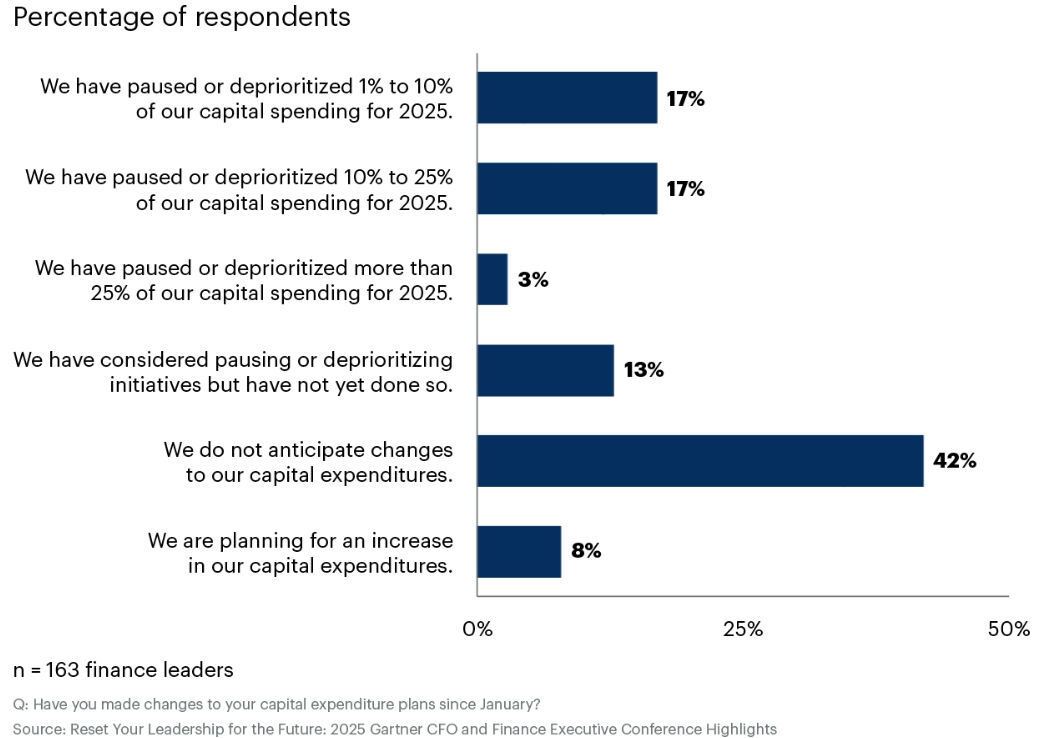
Manufacturing upgrades, office relocations, and large-scale infrastructure investments are among the most commonly delayed, especially in mid-market firms. Several CFOs told The CFO that unless return profiles are “clear and short-term,” those projects are being shelved until early 2026 or later.
“It’s about liquidity optionality,” said a UK-based group CFO. “We want the freedom to respond quickly to further rate hikes or tax changes. That means tightening discretionary spending now.”
That liquidity drive is behind the wave of cost optimisation rippling across sectors. Two-thirds of surveyed finance leaders reported either initiating or planning cost reductions in H2 2025. The cuts, however, are not across the board.

Gone first are lower-ROI software licences, external consulting, and nonessential travel. Contractors and outsourced services are also under scrutiny, as finance teams favour internalising more critical operations.
Yet even amid these cutbacks, one area is proving largely untouchable: AI infrastructure.
Rather than broad pilots or innovation theatre, companies are reallocating spend to automation that improves operational efficiency or enhances decision intelligence. The “AI-for-AI’s-sake” phase is fading, replaced by a disciplined push toward use cases with measurable return.
This shift marks an inflection point in the way CFOs view AI. For many, 2024 was about experimentation — proof-of-concept tools in HR, marketing, and finance. In 2025, that experimentation is being replaced with selective deployment and integration.
In interviews with several finance leaders across the UK and continental Europe, common priorities included:
The emphasis is increasingly on what one CFO described as “enterprise-grade AI,” not sandbox experiments. Budgets are shifting toward internal modernisation — platforms and tooling that streamline core processes and reduce long-term operational cost.
The strategic logic is clear. AI promises not just efficiency gains but a fundamental retooling of the finance function.
From dynamic cash flow forecasting to real-time risk modelling, the benefits are aligned with the CFO’s evolving mandate: to act as a strategic operator, not just a fiscal steward.
Still, the short-term cost pressures are real. With growth sluggish in major markets and earnings under pressure, CFOs must weigh the risks of investing now against the risk of falling behind later.
In Gartner’s data, 33% of respondents reported a strategy of “simultaneously cutting costs in some areas and investing in others,” suggesting a net cost reduction — but not a blanket freeze.
This reallocation mindset — spend less, spend better — is emerging as the dominant playbook.
“There’s no appetite for moonshots,” said the CFO of a consumer goods multinational. “But there’s plenty of appetite for targeted automation that gives us speed and clarity. If it cuts month-end from 10 days to 4, it gets funded.”
The September Gartner CFO & Finance Executive Conference in London will likely sharpen the debate on how finance leaders should navigate this tension.
Key questions loom: How much internal capacity should be built vs. bought? What’s the shelf life of current AI tools as the tech matures? And how can finance teams ensure measurable returns without over-indexing on hype?
One thing is certain: AI is no longer a discretionary investment. It’s a defensive one — a hedge against rising cost, falling productivity, and future complexity.
And for now, it’s the last thing CFOs are willing to cut.