The modern CFO and Head of Tax face a landscape defined by rapid, interconnected change: widening talent gaps, regulatory shifts like legislative and regulatory reforms, and business model transformation. Against this backdrop, EY Global Tax and Finance Operate Leader Stuart Lang and EY Global Managed Services Partner Dave Helmer shared insights from their latest Tax and Finance Operations (TFO) Survey.
The key takeaway? Transformation is no longer a one-time project; it’s a continuous way of operating. Finance leaders aren’t just building flexible, data? driven models—they’re shaping operating structures that can absorb and adapt to whatever the future brings.
Data and Technology Overtake Budget as Top Barrier to Success
The biggest change in the survey results compared to the previous year is the dramatic pivot in perceived barriers to success.
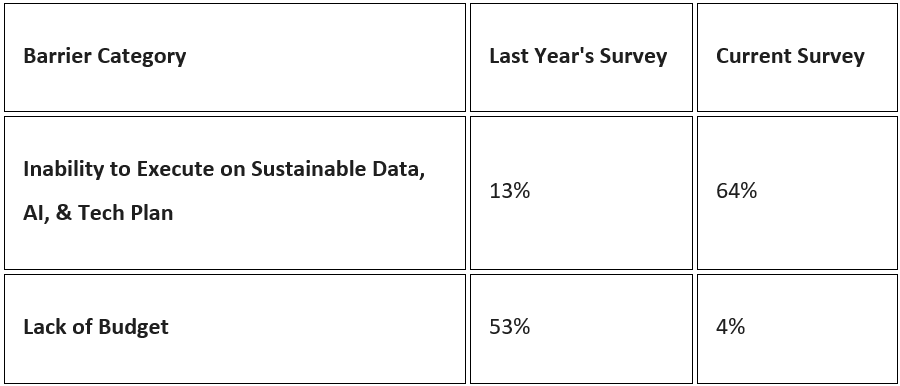
“It’s a really interesting dynamic that’s pivoted from highly cost-conscious 18 months ago, to now looking at the need to have trusted data technology and execute on the strategy,” notes Stuart Lang.
In this year’s survey, the most significant challenges CFOs and tax leaders are facing are:
- Data and AI/Technology Execution: Inability to execute a sustainable plan is now the largest barrier (64%).
- Talent Strategy: Inability to execute on a sustainable talent strategy accounts for 45% of the barrier..
- Advising the Business: 21% cite the inability to adequately advise the business on strategic value initiatives.
Responding to Geopolitical Turbulence
The survey confirms that CFOs are actively restructuring their finance and tax operating models to manage the twin threats of geopolitical turbulence and evolving trade policies. A staggering 81% of companies are predicting moderate to significant changes to their business operations, including their supply chains, over the next 24 months.
The response is two-fold: Centralization and Data-Readiness.
- Centralization Acceleration: There has been an accelerated trend over the past 12 months to move toward more centralization, shifting away from geographically diverse, spread-out organizations. This provides better compliance oversight and enables rapid, coordinated business decisions when volatility hits. This motivation is key in the increased move to shared service centers or global business service centers.
- The Agility Mandate: To manage uncertainty, companies rely on modeling and great data. This ensures they can quickly react to changes in tariffs, trade policies, or legislative developments.
This need for a centralized, coordinated view is compounded by regulatory pressures such as BEPS, with 59% working with a third-party provider to comply with requirements
Similarly, the percentage of companies planning to voluntarily disclose taxes paid has jumped to 80% this year, up from 56% last year and 37% just a couple of years ago.
AI Adoption: The Platform vs. Build Dilemma
AI is top-of-mind for every client, but the survey reveals a clear preference for how to acquire this capability.
Despite the significant buzz around Generative AI, the path to adoption for tax and finance functions shows a clear preference for leverage over internal development. The survey reveals a striking difference in strategy: an overwhelming 83% of companies indicate that the most significant way to take advantage of AI is by working with a service provider that has AI, workflow, and analytics built right into their service offering. This strategic choice reflects the difficulty and risk of building, maintaining, and constantly updating sophisticated AI capabilities in-house, especially when contrasted with the mere 8% of companies that prioritize individually developing and deploying their own AI agents. This suggests that partnering with an established platform offers a faster, more secure, and less risky route to achieving an agile, AI-driven operating model.
Dave Helmer attributes this to the speed of change, noting that working with a provider who has scale, a platform approach, and alliances is “a less risky and potentially cheaper way” than building internally and having to continuously retrofit.
Key AI Use Cases in Tax and Finance:
The current priority areas for AI deployment are focused on predictable, ‘yes or no’ outcomes, which include:
- Data Acquisition and Cleansing: Cited by 81% as a high-priority area.
- End-to-End Automation: Driving automation of compliance processes (79%).
- Analytics and Scenario Planning: Using AI for modeling and future planning (70%).
Examples of Agentic AI in Action:
- Indirect Tax Classification: Gen AI can review product descriptions, ingredients, and tax jurisdiction rules to classify products for sales/use tax or VAT purposes.
- Government Notice Processing: Technology is deployed to download new notices, which Gen AI then reviews to classify the tax type and jurisdiction, documenting the data and routing it via workflow to the correct specialist.
However, the maturity level is still low, with 41% of companies in the exploratory phase and 18% non-existent in their AI development. The single greatest barrier to advancing an AI strategy remains insufficient AI-ready data.
Furthermore, Stuart Lang suggests that trust is still an issue, particularly for large language models (LLMs) used in the probability-based world of strategic finance.
Advice for the CFO and a Look Ahead
Stuart Lang’s Advice:
- Focus on the Data Fabric: Build an underlying data fabric at the lowest granularity possible to ensure analytics and value can flow from it.
- Empower New Skills: When bringing in new talent (like data scientists), ensure they have adequate technology deployment to implement their insights.
- Accelerate Governance and Standards: The “unsexy part of the world” remains crucial: going back to basics with standards and governance around quality, trust, and data.
Dave Helmer’s Advice:
- Slow Down to Go Fast: In this environment of constant, interconnected change, you need a trusted partner to evaluate your operating model and ensure you have an agile function in place to adapt quickly.
Future Trends: From Fundamentals to Value-Driven Insights
Looking ahead, Stuart Lang expects the conversation to move away from the fundamentals of automation and basics towards driving value. “I would expect forward – thinking CFOs and Heads of Tax to start moving away from automation … and pushing the boundaries of they can leverage the fundamentals to drive value for their organization,” he predicts.
This may even lead to the CFO challenging departmental and business strategies based on insights derived from the broad organizational data they now access.
Dave Helmer concurs, predicting that data, technology, and AI will continue to play a much bigger role in relieving the pressures around the talent gap, tariffs, and legislative disruption.