Why your 2026 year-end is a launchpad rather than a finish line
The calendar might say 2026, but for the modern finance leader, the year-end isn't a finish line, it’s a pivot point. As we balance the rigid requirements of reporting with the fluid demands of a shifting economy, we explore how to turn your compliance data into a high-beam strategy for the months ahead.
The calendar might say March, but for the modern finance leader, the “Year-End” isn’t a date, it’s a state of mind. As we sit here in early 2026, US-based CFOs are likely exhaling after a grueling 10-K season, while our UK counterparts are staring down the barrel of the April 5th tax year-end.
At The CFO, we know that this period is less of a “finish line” and more of a “pivot point.” It is the moment where we stop accounting for the past and start engineering the future. But how do you balance the rigid requirements of reporting with the fluid demands of 2026 planning?
The Rearview Mirror: Reporting with Precision
Reporting is often viewed as the “compliance tax” of the finance world. However, in an era where data is the new currency, your year-end report is your brand’s strongest proof of concept.
1. The Death of the “Slow Close”
In 2024, a survey of mid-to-large-cap firms showed that the average time to close the books was about 6.4 days. By now, in 2026, that “gold standard” has dropped. If your team is still hunting for receipts in Prussian Blue folders three weeks after the quarter ends, you aren’t just behind, you’re losing strategic ground.
2. Integrity Over Aesthetics
While our brand loves a vibrant palette, your financial statements shouldn’t be “creative.” The SEC and the UK’s Financial Reporting Council (FRC) have significantly increased scrutiny on “adjusted” EBITDA and non-GAAP metrics.
The High-Beams: Planning for the “Unknown Unknowns”
If reporting is the rearview mirror, planning is the high-beams. We are operating in a 2026 economy defined by fluctuating interest rates and the “Second Wave” of AI integration.
Dynamic vs. Static Budgeting
The annual budget is dead. Long live the rolling forecast. US firms, in particular, are moving toward a 12-month rolling model that adjusts for real-time inflationary shifts.
The 30% Rule: Just as we balance our brand’s use of White and Prussian Blue at 30% each, consider allocating 30% of your capital expenditure to “Adaptive Growth” funds that can be pivoted within 48 hours based on market triggers.
The UK Angle: For those with UK operations, the focus remains on navigating post-Brexit regulatory divergence and the evolving “Green Taxonomy” reporting. Planning now requires a dual-track approach: one for the SEC, one for the FCA.
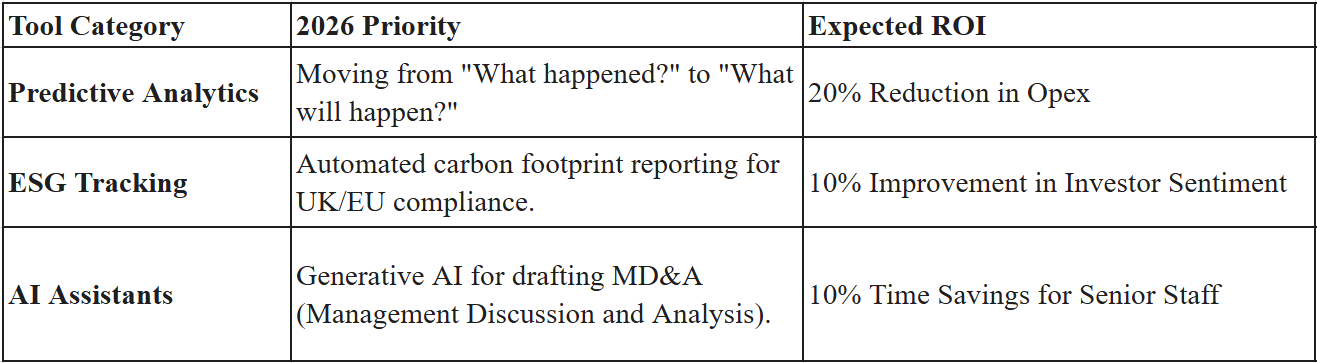
The 2026 Tech Stack
We’ve all been there: 2:00 AM, a cold cup of coffee, and a spreadsheet that refuses to calculate. At The CFO, we advocate for a tech stack that reflects our commitment to clarity and accessibility.
Data is cold; stories are warm. As a CFO, your job is to translate the Cobalt Blue depth of your balance sheet into a narrative that the Board and your employees can get behind.
When you present your year-end findings, don’t just show them the “what.” Show them the “so what.”
Don’t say: “We increased cash reserves by 12%.”
Do say: “Our 12% increase in liquidity provides us the ‘Sunglow Yellow’ opportunity to acquire a competitor or hedge against Q4 volatility.”
The CFO’s Checklist
As you move through this reporting and planning cycle, keep the “Safe Space” in mind, much like our logo’s exclusion zone. You need a buffer between your data and your decisions.
Verify the Data: Ensure your “Main Brand Typeface” (the truth of your numbers) is consistent.
Stress Test: Run a “Worst Case” scenario based on 2026 geopolitical tensions.
Rest: A fatigued CFO is a risk. Take a moment to step away from the screen before the final sign-off.
Reporting isn’t just a look back; it’s the foundation for the leap forward. Let’s make 2026 the year we stop counting value and start creating it.