As we cross into the second half of 2026, chief financial officers are finding themselves in a high-stakes balancing act. The global economic backdrop remains complex. The International Monetary Fund (IMF) projects that advanced economies will see modest GDP growth around 1.7% in 2026, with the United States pacing ahead at 2.3% and the United Kingdom trailing at 1.0% as sticky cost pressures linger. According to recent Federal Reserve data, CFOs remain highly concerned about sustained input cost pressures, noting an ongoing challenge in deciding how much to pass through to consumers.
Yet, despite this cautious macroeconomic backdrop, there is one line item where the corporate purse strings are loosening at an unprecedented pace: Artificial Intelligence.
Data from the Gartner C-Level Communities 2026 Perspective Survey reveals that increasing operational efficiency and productivity has officially emerged as the leading enterprise-wide priority for CFOs. Concurrently, mid-market data from the Consero 2026 CFO Survey indicates that the deployment of fully embedded AI in finance has surged by 91% year-over-year. For finance chiefs, this massive influx of capital presents a unique structural challenge, navigating the AI “J-Curve”.
Understanding the J-Curve
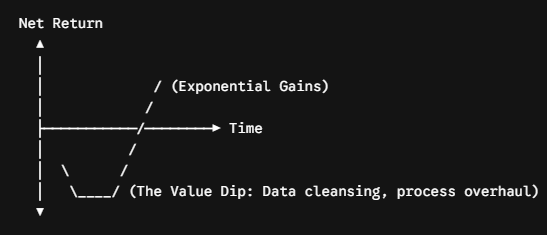
In corporate finance, the J-Curve represents a period where a major strategic investment causes profits and productivity to drop initially due to implementation costs, organizational disruption, and system complexities before turning sharply upward to deliver a true return on investment (ROI).
Historically, CFOs have managed technology expenditures through rigorous, multi-year business cases. However, the current velocity of agentic AI tools and knowledge-work automation is obliterating traditional planning cycles. While the technology promises massive long-term advantages, 84% of CFOs surveyed by Gartner have not yet realized a full return on their AI investments in finance, highlighting the depth of the initial “dip.”
“This is no time for analysis paralysis,” note mid-market finance leaders navigating the current paradigm. The danger today is two-fold: the cost of inaction (falling behind competitors who successfully capture early efficiency gains) vs. the cost of operational disruption.
A stark reality highlighted by Deloitte’s 2026 Finance Trends research shows that AI has officially become table stakes, with 87% of CFOs predicting that AI will be extremely or very important to their finance department’s operations this year. Furthermore, 54% of financial leaders are prioritizing the integration of autonomous AI agents directly into workflows over the next 12 months.
Funding Innovation Through Existing Efficiencies
Corporate boards and public markets are growing less tolerant of long-duration investments that permanently inflate a company’s baseline expenses. Macro analysis by PwC shows that trillions of dollars in global value are shifting as structural megatrends reconfigure industries. Investors want clear evidence that near-term revenue momentum is translating directly into operating leverage.
To survive the dip of the J-curve, leading CFOs are adopting a “self-funding” mandate. Rather than expanding the aggregate expense base, finance teams are being tasked with extracting savings from legacy systems and internal reallocations to fund new AI pilots. In fact, Deloitte’s research points out that 49% of CFOs are actively hiring or promoting from within to keep human capital costs strictly managed while accelerating these digital shifts.
AI Investment Strategy
|
Old Playbook (Pre-2025)
|
New Playbook (2026 Strategy)
|
Funding Model
|
Net-new capital expenditure allocations.
|
Self-funding out of structural cost reductions.
|
ROI Timeline
|
Fixed 3-to-5 year payback periods.
|
Milestone-based iterative experimentation (3–6 month targets).
|
Risk Focus
|
Execution and deployment delays.
|
Balancing execution risk against the risk of stagnation.
|
The CFO Action Plan
To effectively bridge the J-curve without compromising corporate liquidity, modern financial leaders are pivoting toward three concrete execution steps:
-
Tolerate Controlled Failures: Shift from broad enterprise rollouts to milestone-based, iterative pilots. If an AI forecasting or variance analysis tool does not demonstrate early efficiency indicators within 6 months, execute tight kill-switches.
-
Prioritize Data Quality Over Tool Selection: According to market benchmarks, data readiness is cited as the #1 structural barrier to achieving AI ROI. Direct capital toward clean, integrated internal data pipelines before purchasing expensive front-end layers.
-
Unlock M&A Efficiencies: Don’t rely solely on organic transformation. With 63% of North American CFOs reporting a greater interest in mergers and acquisitions this year compared to last, forward-looking firms are using consolidation to acquire advanced tech stacks and specialized digital talent simultaneously.
Ultimately, the challenge of AI adoption will test the operational flexibility and strategic judgment of the modern CFO far more than the cloud or dot-com booms did. The finance leaders who successfully bridge the J-curve will be those who view AI not as a standard IT expenditure, but as a fundamental rewiring of the corporate cost curve.