How continuous auditing frees CFOs to focus on strategy
Discover how enterprise CFOs leverage continuous auditing AI to automate multi-ERP reconciliations, manage risk, and speed up close cycles.
Discover how enterprise CFOs leverage continuous auditing AI to automate multi-ERP reconciliations, manage risk, and speed up close cycles.
When fintech enterprise vendor Sixthfin announced the separation of its chief executive and board chair roles, the news likely registered as routine corporate governance. Former CEO Jean-Marc Allouët moved to Executive Chairman to focus purely on product engineering, AI development, and R&D. Meanwhile, software veteran François Vallana stepped into the CEO position to focus on scaling global operations, expanding commercial distribution, and refining execution.
To a casual observer, it looks like a standard playbook transition for a venture-backed tech firm maturing past its initial startup phase. But for enterprise Chief Financial Officers managing multinational organizations, this specific structural pivot reflects a much larger, operational shift occurring within their own finance departments: the growing necessity to decouple high-level strategic financial vision from everyday operational controls and continuous audit compliance.
This structural tension currently plays out directly on the desks of modern enterprise finance leaders. Over the past decade, the role of the CFO has expanded well beyond core stewardship into full strategic leadership, with finance executives taking the lead on capital allocation, M&A, investor relations, and long-term value creation. However, finance chiefs still remain legally and operationally anchored to entity-level account closes, multi-ERP reconciliations, and continuous regulatory compliance across foreign subsidiaries.
Attempting to manage both domain extremes manually creates severe operational friction. Strategic responsibilities like M&A integration or capital efficiency require continuous executive focus, yet repetitive month-end close execution constantly pulls leadership back into tactical oversight. To resolve this tradeoff, enterprise finance organizations are increasingly adopting the same structural division of duties seen in high-growth tech firms: deploying automated continuous control infrastructure to absorb the operational heavy lifting of compliance and ledger reconciliation, thereby granting the executive office the operational bandwidth needed to focus entirely on enterprise strategy.
The structural governance challenges faced by scaling vendors stem directly from the complex operating environments of their enterprise clients. Finance departments operating across multiple jurisdictions, spanning US GAAP, UK IFRS, and local European statutory rules face severe operational drag due to system fragmentation.
Consider the reality of mid-market to enterprise accounting infrastructure:
ERP Fragmentation: Large multinational groups frequently run anywhere from three to over thirty distinct ERP systems across legacy acquisitions.
Manual Reconciliations: finance teams routinely spend up to six business days per accountant every year navigating manual journal entries and spreadsheet-based account reconciliations.
Sampling Gaps: Traditional internal audit relying on post-close sample testing captures less than 5% of actual ledger transactions, leaving organizations vulnerable to fraud and compliance blind spots.
When financial controls rely on fragmented, manual checks, the quarterly close becomes a bottleneck that pulls finance leadership away from strategic corporate planning.
To break this operational cycle, corporate finance teams are aggressively adopting continuous audit and automated risk-detection architectures. Instead of inspecting data retrospectively weeks after period-end, platforms like Sixthfin monitor transactional activity continuously across connected systems.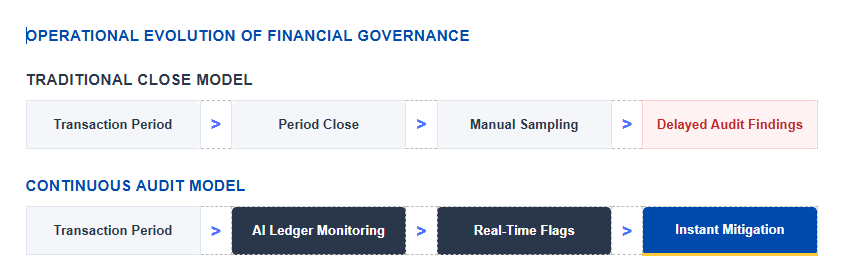
Transaction-Level Coverage Over Manual Sampling: By applying automated rules and machine learning directly to unified ledger data, organizations scan 100% of journal entries for anomalous patterns, improper segregation of duties, or duplicate disbursements.
Accelerated Financial Close Cycles: Co-designed closing platforms streamline transaction matching and variance explanations. Finance departments deploying automated close orchestration routinely compress their monthly close timeline while reducing post-review journal adjustments.
Regulatory Future-Proofing: Heightened regulatory scrutiny, such as the UK’s Economic Crime and Corporate Transparency Act (ECCTA) and evolving SEC disclosure requirements in the US places strict accountability on corporate officers for fraud prevention. Real-time audit trails provide documented proof of continuous internal controls.
Just as technology companies must separate leadership roles to ensure focused execution, CFOs must systematically decouple their team’s strategic capacity from repetitive control execution.
Achieving this requires establishing a centralized data layer that harmonizes accounting data across all ERPs, replacing manual sampling with automated risk flagging, and embedding continuous control workflows directly into the monthly closing process.
By automating transaction monitoring and risk oversight, finance executives free their leadership teams from the noise of routine reconciliation allowing them to focus on driving profitable corporate growth.