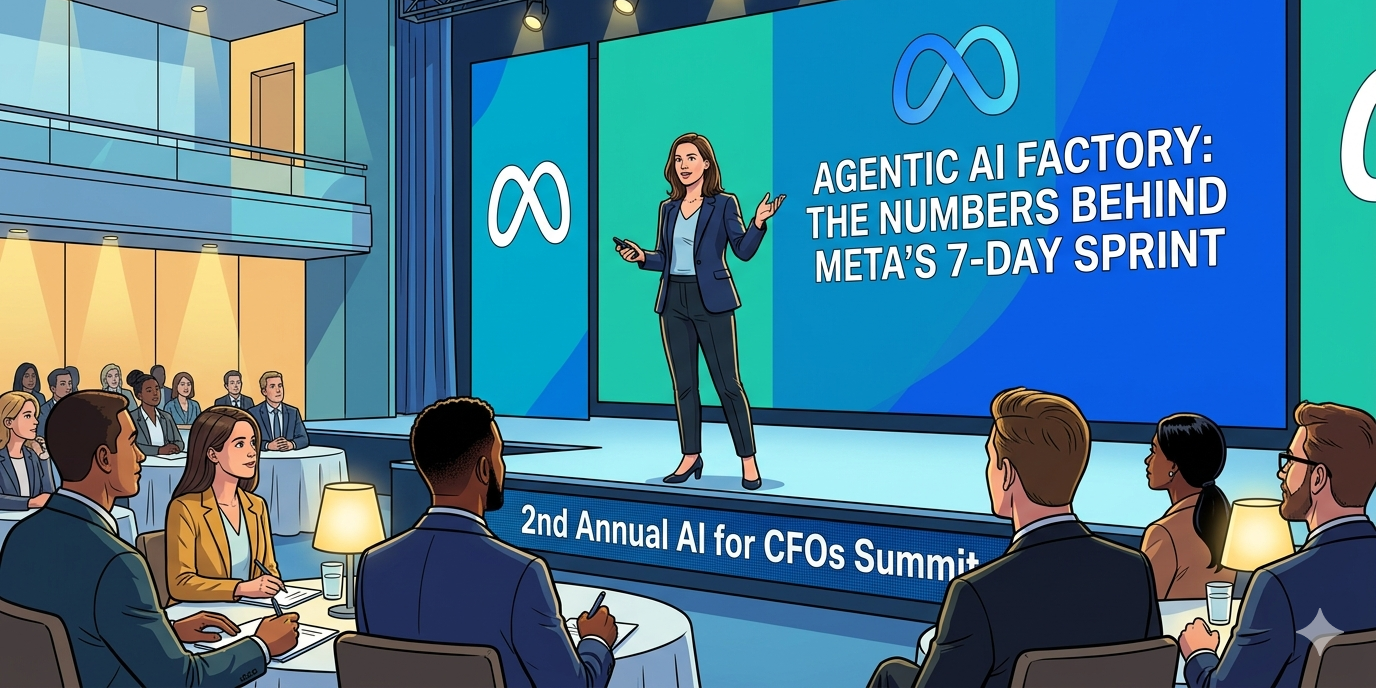
For readers of The CFO, the phrase “AI transformation” often feels like a corporate buzzword designed to sell consulting hours. But when Ailbhe Moynihan, Finance Director at Meta, took the stage at the 2nd Annual AI for CFOs summit, the conversation shifted from the theoretical to the mechanical.
Meta isn’t just “piloting” AI; they have built what Moynihan calls an “Agentic AI Factory”. For a company that saw revenue skyrocket from $2 billion in 2010 to $200 billion in 2025, the central challenge was simple but daunting: how do you support exponential growth without an exponential increase in headcount?
The answer lies in moving beyond basic automation and into the world of autonomous “agents.”
The 7-Day Sprint: From 100% to 7%
The most striking statistic shared during the session involved Meta’s revenue operations, which handle a staggering 600,000 invoices every month. In this high-volume environment, even minor manual interventions create massive bottlenecks.
Meta deployed agentic AI to handle field editing, the often tedious process of correcting or updating invoice data. Using traditional methods, the manual workload was constant. However, within just seven days of deploying their agentic models, Meta saw a field editing improvement that effectively moved the needle from 100% manual intervention to just 7%.
They didn’t just automate a task; they collapsed a process. By utilizing models that could understand context and pull from multiple data sources, they reduced the complexity of tasks that previously required editing 30 different fields down to just three or four.
The “Greenfield” Philosophy
Moynihan was clear that this success wasn’t an overnight win. It was the result of a “greenfield approach” a complete reimagining of the finance process from the ground up.
“We were working for 18 months on PowerPoint,” Moynihan revealed. Before a single system was built or a line of code was written, the team spent a year and a half designing the processes, setting up the system architecture, and ensuring the data “plumbing” was flawless. This meticulous preparation allowed them to move from isolation to enterprise-wide AI quickly once the technology was ready.
Collapsing the Procurement Cycle
The “Agentic Factory” at Meta is now aimed at one of the most stubborn metrics in finance: the procurement and ad cycle. Historically, this has been a 10-day process fraught with manual approvals and data entry.
Meta’s goal is to use agentic AI to compress this 10-day cycle into a single day. By using agents that can autonomously navigate multiple systems, moving beyond the “deterministic” rules of old-school automation. Meta is enabling its finance team to act as “architects of systems” rather than processors of data.
The Human Element: Training “Digital Delegates”
Despite the high-speed automation, Moynihan and other leaders at the event emphasized that the “Human in the Loop” remains critical. The goal isn’t to remove the finance professional, but to change their job description.
At companies like Bosch, which works alongside Meta’s principles, they have implemented “digital delegates” in every department to champion AI adoption. The philosophy is that AI will not replace managers, but managers who incorporate AI will undoubtedly replace those who don’t.
The CFO Takeaway
Meta’s journey offers a blueprint for any finance leader looking to move beyond the pilot phase:
- Don’t Pave Over Chaos: Spend the time (even 18 months, if necessary) to redesign your processes before applying AI.
- Focus on Scale: Look for high-volume areas like invoicing where “agentic” agents can autonomously plan and take action across systems.
- Measure Velocity: If your procurement cycle is 10 days, your AI goal should be one day. Velocity is the new KPI.
As Moynihan concluded, the transition to AI is less about the technology and more about the “truth of the situation”. With the right data and the right agents, the finance team can finally stop working on the board report the night before and start acting as the strategic partners the business requires.