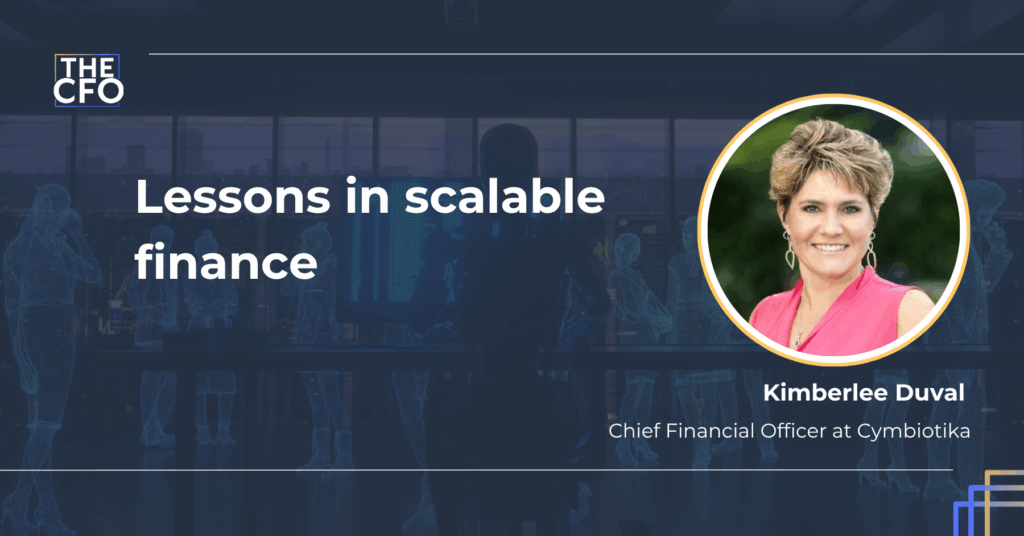
Kimberlee Duval joined Cymbiotika a little over a year and a half ago, and it was a “match made in heaven,” as she described the fit, but the work has been anything but simple.
The company hit a pivotal moment as it pushed from a fast-growing direct to consumer model into retail with partners like Sprouts and The Vitamin Shoppe. That shift exposed gaps in processes, systems and forecasting that threatened cash and execution just as demand spiked.
Duval’s response was classic finance leadership with a modern edge. “The best CFOs are the ones that do not just look at the numbers,” she says. “I look at the data, of course, but how does that come together with the people, with the vision, with the goals of the organization, to then drive action.”
Retail is a different animal from direct to consumer. “Very few people in the organization really knew or understood what that meant,” Duval recalls. Inventory planning, channel marketing and accounting for retail programs all arrived at once, exactly when Cymbiotika posted the biggest quarter in its history.
“That immediately put us into this kind of cash crunch situation,” she says. Conversations with vendors turned from price to timing. “We’re not going to not pay you. We just need some time. Can we work on terms with you? Can we work on payment plans with you?”
The lesson was not to slow growth, but to build the rails that let growth keep its momentum. “We really have to spend less time putting the data together and more time with what we do with it,” she says. “Things change by what feels like the moment.”
That urgency reframed technology decisions too. NetSuite was already being implemented when Duval arrived, but her first months showed it would not scale as configured. “This is not set up correctly,” she says. “We were not on OneWorld, and we should have been, because we had multiple currencies and multiple subsidiaries.”
Even basic master data, like items and subsidiaries, needed another pass. “One of the best things about NetSuite is how flexible it is. One of the worst things about NetSuite is how flexible it is,” she says.
Without a clear end state, flexibility turns into rework. “Measure twice, cut once,” is Duval’s mantra. Decide whether you will need a channel P and L. Decide how you want to aggregate direct to consumer buyers. Decide how the business needs to see performance, then set structures and standard operating procedures to match. If not, the consequence is predictable.
“Garbage in garbage out,” she says, and that applies to workflow design and training as much as it does to data.
Duval’s view of the CFO job is as much about enabling as it is about gatekeeping. “A lot of what I do is not just about pulling the information together or telling people no,” she says. “It’s really more about empowering. How do I give them information that helps them to do their job better, to do it faster, to do it more efficiently.”
That orientation becomes critical when channels multiply. Why a customer returns, why they buy, where they buy and why they choose Amazon over a brand site or a specialty retailer all change margin, marketing and service obligations. The finance function, in her telling, has to connect those dots in near real time and then help teams act on them.
That same balance shows up in how she is approaching AI. Duval calls herself a fan of technology, but she wants to explore it further.
Part of that tension is human. New agentic workflows are either thrilling or worthy of further consideration depending on where you sit. “To adopt for adoption’s sake, no. To adopt well, thoughtfully understanding compliance considerations, accuracy, if it’s the right fit at the right stage, these things must be considered as well.”
She is also explicit about keeping people “in the loop,” she says, noting that NetSuite already blends classical machine learning with generative tools and agentic patterns. The point is not to hand the keys to automation, but to let skilled people make better calls with less friction.
Natural language is part of that. Finance teams want to ask for a balance sheet, an operational cash flow or a quarterly margin and get it in seconds. They want to ask more complex questions as channels and products multiply and have the system respond in a way business users can understand.
“It has to be humanized from the beginning,” she says. The model needs to return more than a chart. It has to tell the story in terms that matter to the person on the other end, or it will sit in an inbox unread.
The same philosophy guides Cymbiotika’s brand stance. Duval connects finance to customer trust. The company has chosen ingredient integrity over lowest cost and publishes test results openly.
A Target buyer will call the brand instead of the store. The obligation to educate, to answer health questions and to recommend the right product does not end at the point of sale. Ongoing dialogue as essential to product roadmaps and to the community Cymbiotika wants to build.
Underneath the systems and strategies is the most human part of the CFO job. “Hiring and firing people are the most human decisions I’ve had to make,” she says. She does not take either lightly. That answer fits the rest of her posture, expecting herself to be the meter that tests hype against outcomes.
The next two years at Cymbiotika will test those instincts across channels. As retail expands, the data, the marketing and the conversations around products will all change. The finance function will have to change with them. That is why Duval keeps returning to the starting point. “What is the outcome we want. What question are we trying to answer. Who needs to act on it. Only then does the conversation turn to structures, reports and tools. It is not that standard reports are useless. It is that reports without context and intent waste everyone’s time. The work is to make the story clear and actionable for the person who needs it next.”
Duval is leaving SuiteWorld with more options, more questions and a team ready to try new approaches the right way.