Nvidia hits 56% growth without China in the mix
Nvidia's record-breaking performance highlights the ongoing demand for AI infrastructure, even as China tensions cloud future growth.
Nvidia's record-breaking performance highlights the ongoing demand for AI infrastructure, even as China tensions cloud future growth.
Nvidia has reported $46.7 billion in revenue for its fiscal second quarter, marking a 56% increase from the same period last year and reaffirming its central role in the artificial intelligence investment wave.
The results, released Wednesday evening, slightly surpassed Wall Street expectations and signaled continued enterprise appetite for AI capabilities despite geopolitical uncertainties and rising expectations from the capital markets.
The Santa Clara-based chipmaker, now valued at over $4.4 trillion, attributed much of its growth to sustained demand from tech giants including Meta, Microsoft, and Amazon, all of which are aggressively investing in AI-enabled infrastructure.
Revenue from Nvidia’s data center segment alone reached $41.1 billion, a 56% rise year-on-year.
“The AI race is on, and Blackwell is the platform at its center,” CEO Jensen Huang told analysts, referencing the company’s next-generation chip platform, Blackwell Ultra, which is now in full production.
Huang described demand for AI infrastructure as “extraordinary,” noting that annual spending by four major tech customers has doubled to $600 billion.
Despite the strong financials and a bullish forecast of $54 billion in revenue for the upcoming quarter (excluding potential China-related sales) Nvidia shares fell more than 3% in after-hours trading.
Analysts attributed the dip to the company’s high valuation and tempered data center performance relative to expectations.
The quarter’s results came against the backdrop of escalating US-China trade tensions that continue to impact Nvidia’s access to key markets.
The company confirmed it has yet to ship any of its H20 AI chips to China, despite receiving some export licenses following the Trump administration’s recent decision to partially lift a ban on the product. Nvidia is required to pay the US government 15% of revenue generated from any licensed China sales.
While China previously accounted for 13% of Nvidia’s revenue, no sales to the region were recorded this quarter. The administration’s broader strategy to curb advanced AI chip exports to China, aimed at safeguarding US national security interests, has complicated Nvidia’s prospects in what was once its largest overseas market.
“We continue to work through geopolitical issues,” CFO Colette Kress said during the earnings call. The company is also lobbying for approval to export its latest Blackwell chips to China.
Despite the absence of Chinese sales, Nvidia’s results have been welcomed as a signal that global AI investment remains robust. Its chips underpin many of the largest generative AI platforms, including OpenAI’s ChatGPT and Google’s Gemini, and the company is widely seen as a bellwether for broader tech sentiment.
Yet some market watchers are sounding caution. “The law of large numbers seems irrelevant here,” said Matt Britzman, senior equity analyst at Hargreaves Lansdown.
“Nvidia continues to defy expectations, but the market is now demanding a level of performance that leaves no room for shortfall.”
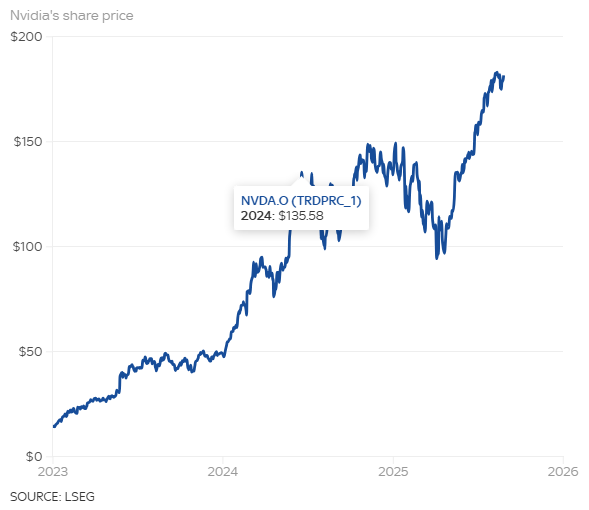
Investor expectations have been further fueled by the stock’s meteoric rise. Nvidia has gained more than 30% so far this year, and its shares have multiplied over 11 times since early 2023.
With revenue growth still outpacing most of the S&P 500, Nvidia’s leadership sees continued momentum ahead. However, regulatory risk, particularly surrounding China, remains a drag on market sentiment.
Beijing’s recent directive discouraging local firms from doing business with Nvidia adds another layer of complexity to any long-term outlook.
“The AI revolution is in full swing,” The Kobeissi Letter noted this week. “Just imagine what will happen to this stock if the China business even comes half back to life.”